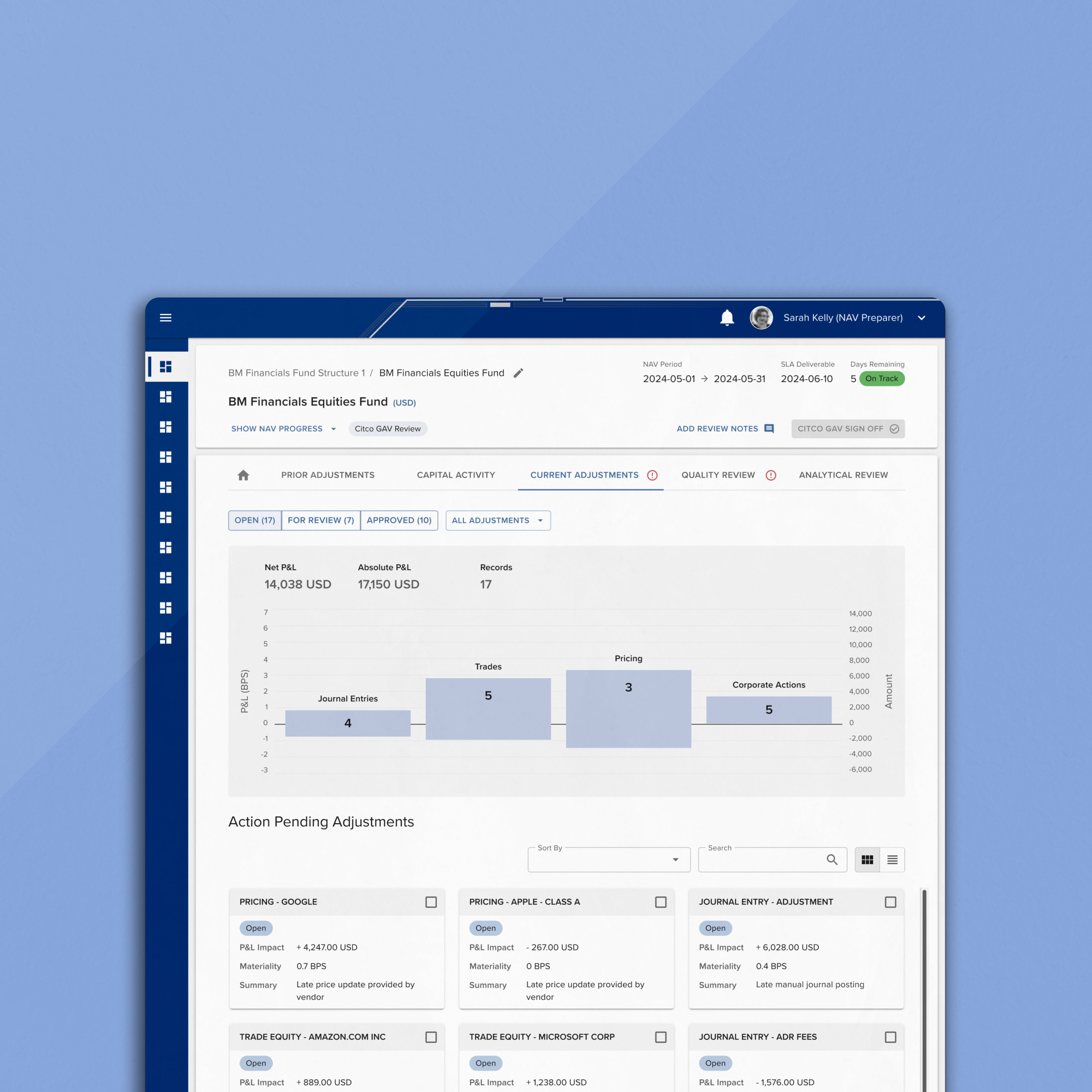
Overview:
Designing a 0 → 1 fund accounting platform to reduce operational touchpoints by ~70% and improve task efficiency by 25-35% across complex financial reporting workflows.
Role:
Lead Designer
Team:
Product Lead, Business Analyst, Intermediate Designer, Development, Fund Accountant SMEs.
Before we begin
To comply with my non-disclosure agreement, I have omitted and modified confidential information in this case study.
Setting the North Star
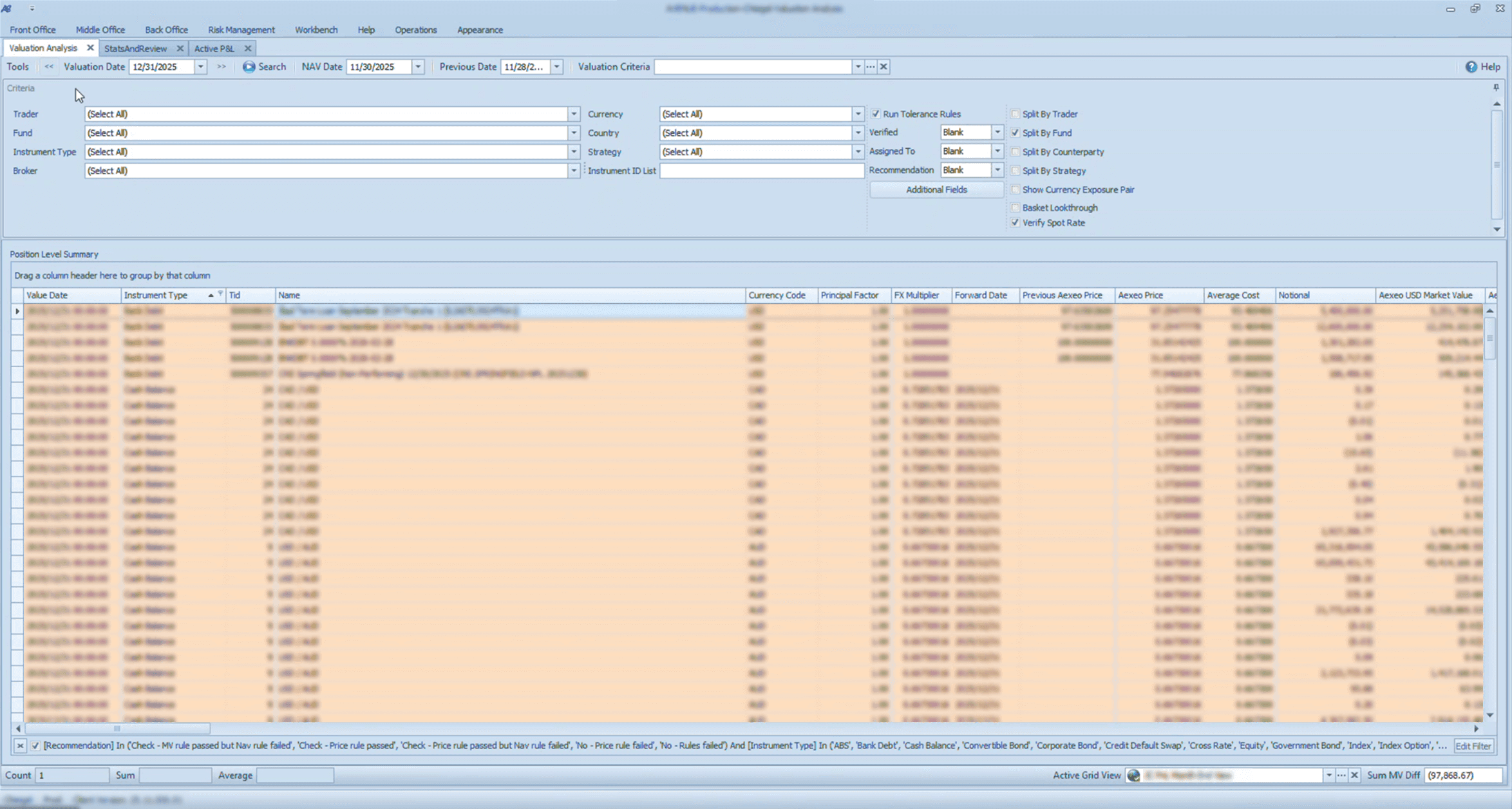
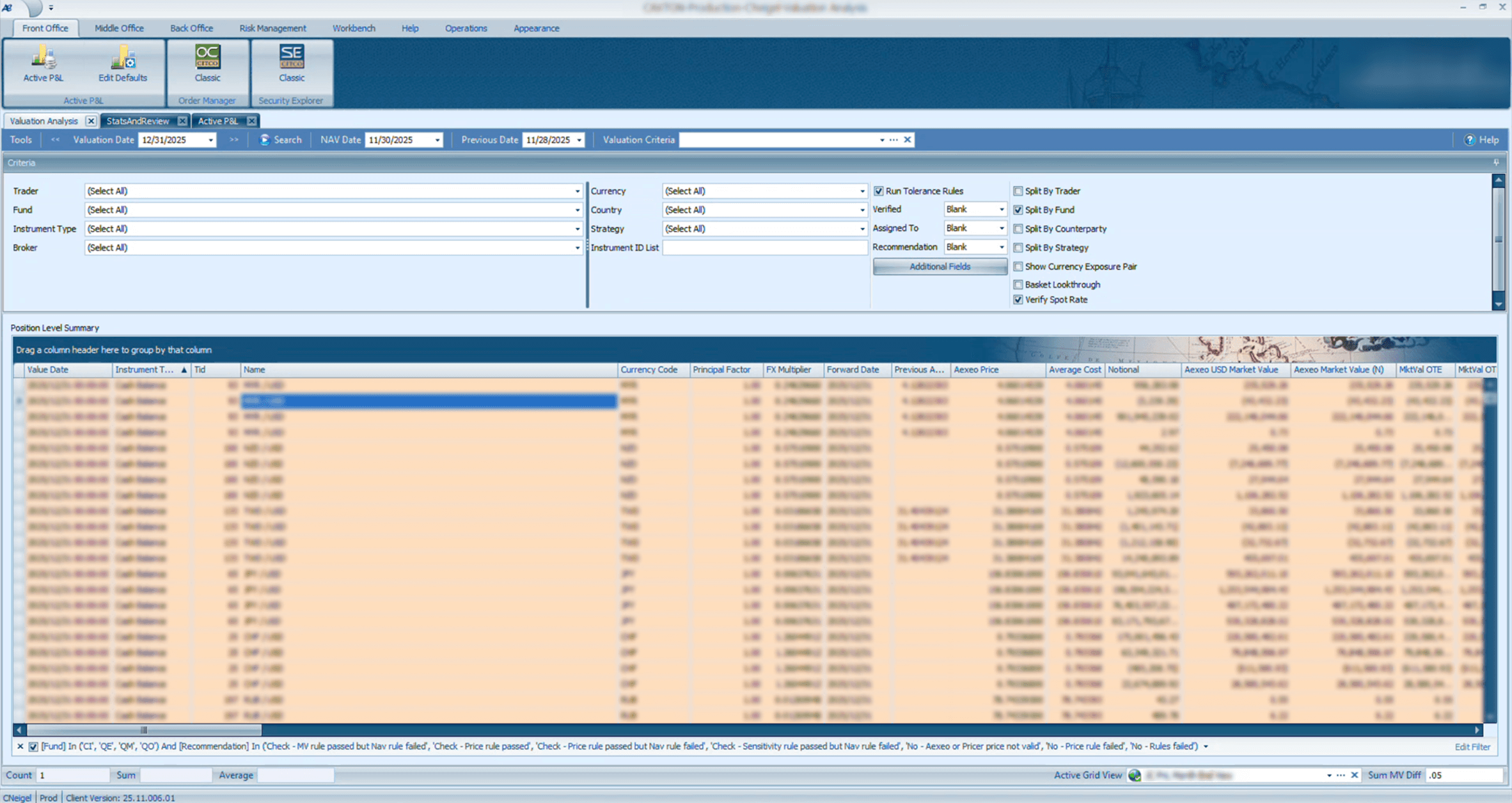
Fund accountants operate within a fragmented legacy ecosystem with no single source of truth, leveraging manual processes, offline spreadsheets and siloed communication to complete the NAV workflow.
This fragmented approach leads to increased risk of error, slow month-end close and reduced transparency and audit confidence across the NAV workflow.
The Goals?
🎯
Centralise workflows to replace outdated tools and reduce reliance on offline work.
⚠️
Reduce operational risk and errors by surfacing key tasks and issues in real time.
📄
Support better decision-making under pressure, presenting the right data at the right time.
🛡️
Increase transparency and audit readiness by embedding communication and decisions within the platform.
📈
Design for scale and sustainability by establishing patterns that will cater for growth.
The Discovery Phase
Objectives:
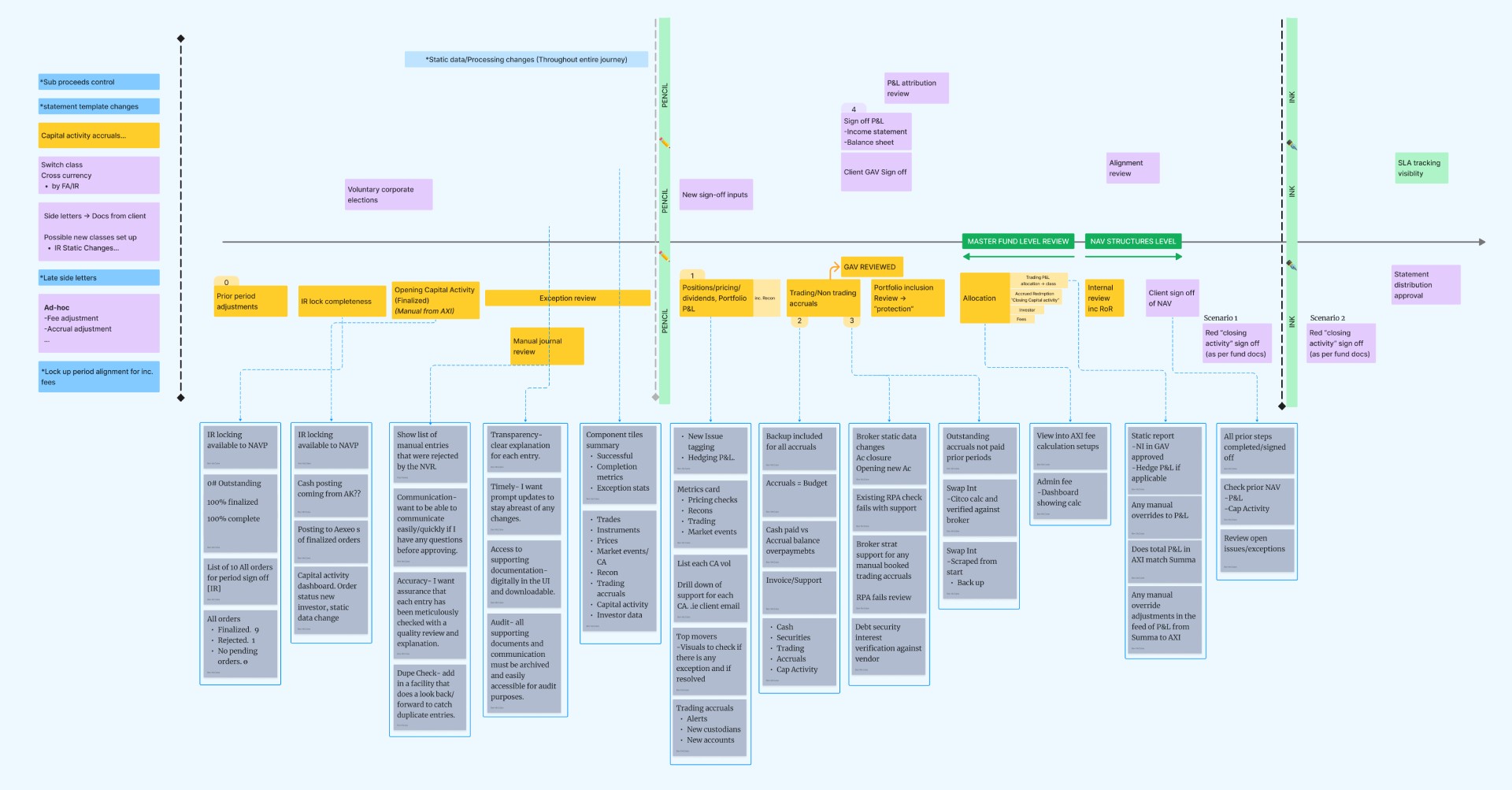
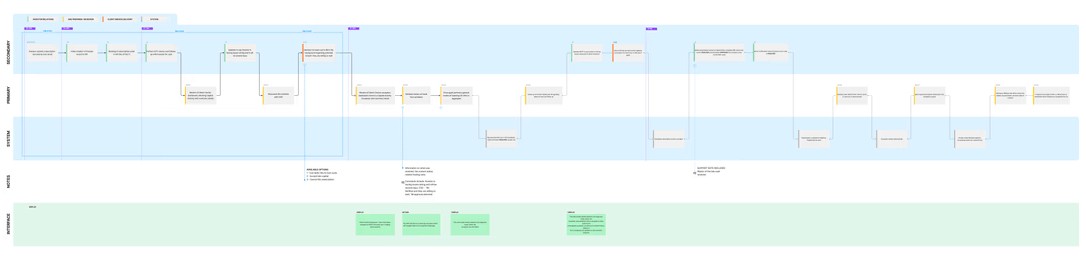
Outline the overall standard flow of NAV completion to NAV delivery.
Identify pain points across data sourcing, exception handling and approvals.
Reviewing workflow and dependencies across tools, teams and data sources.
Uncover opportunities for automation, prioritization and proactive alerts.
Methods:
Contextual enquiries with lead and senior accountants.
Process shadowing and system walkthroughs
Artefact analysis (spreadsheets, workbooks, email chains)
Key Insights:
Fragmentation & cognitive overhead. Accountants navigated between 6 - 9 tools to complete NAV.
Exception handling drives workflow. The real bottlenecks were exceptions - unmapped accounts, missing data, stale numbers.
No single view of NAV readiness. Teams lacked a clear picture of where a fund stood in the daily/monthly cycle.
Time pressure amplifies complexity. Month-end close required speed, but tools slowed users down rather than supported them.

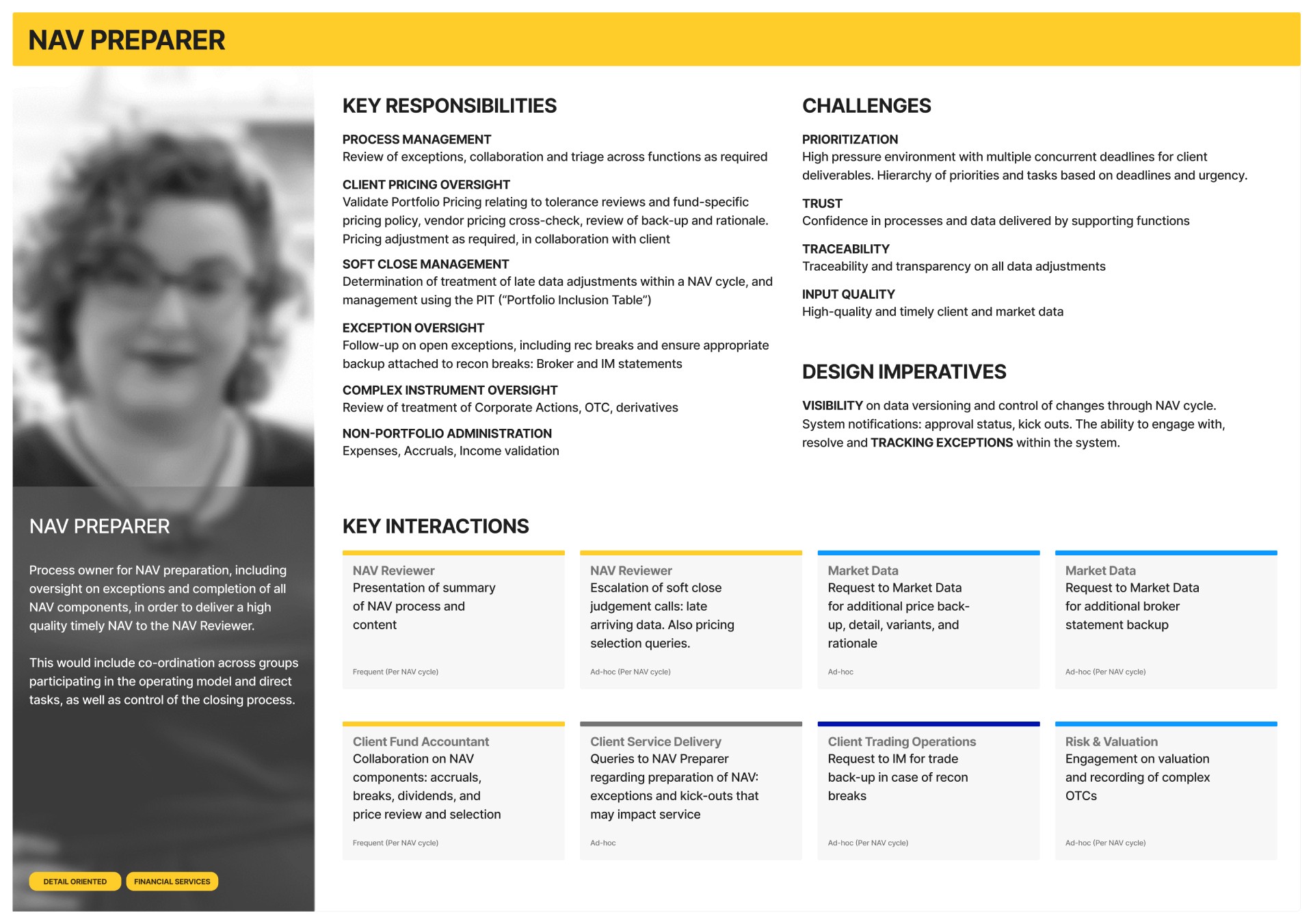
The Personas:
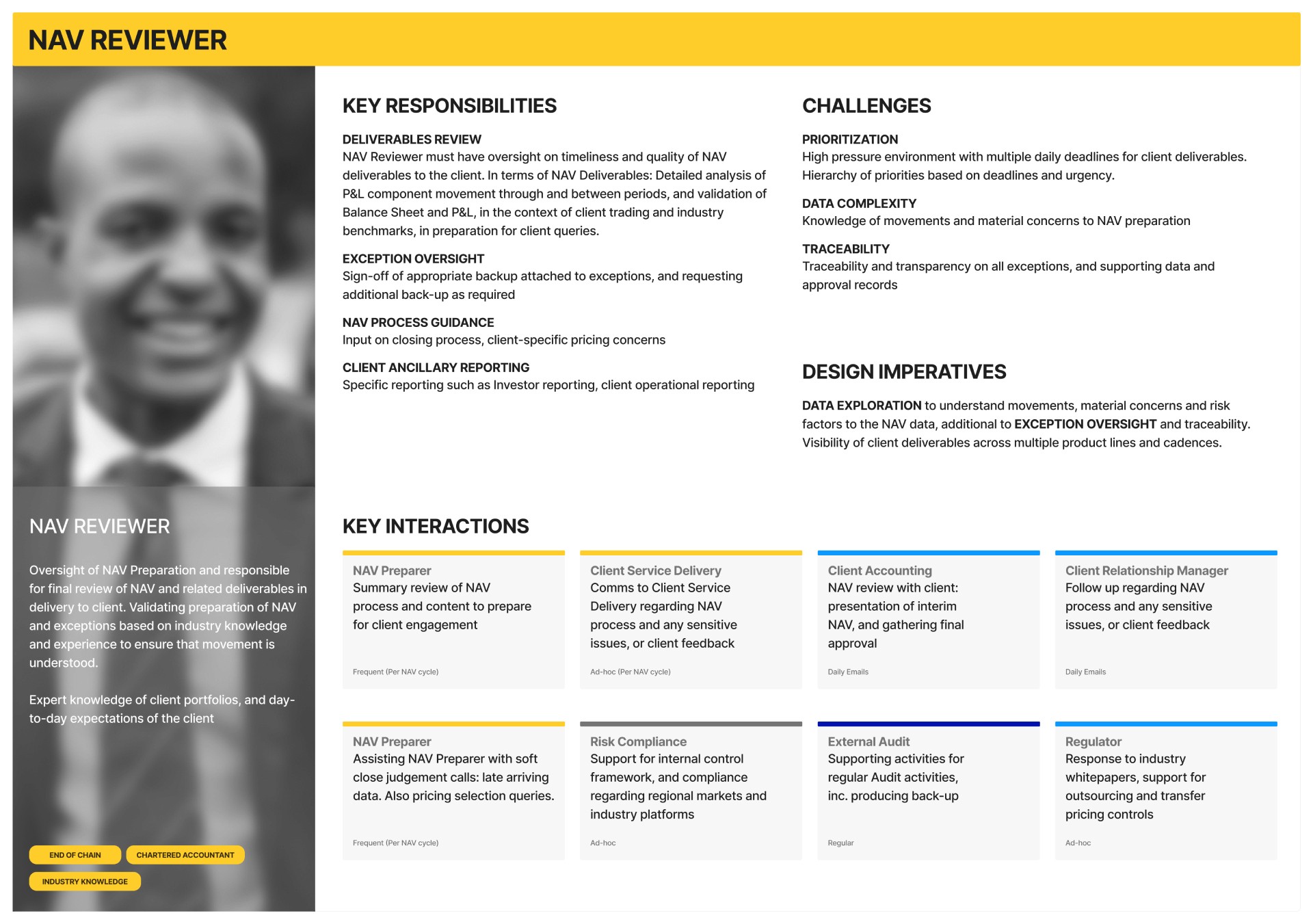
The NAV process follows a maker-checker model where NAV preparers review first and NAV reviewers approve and resolve the exceptions.
Aligning on the Real Problems
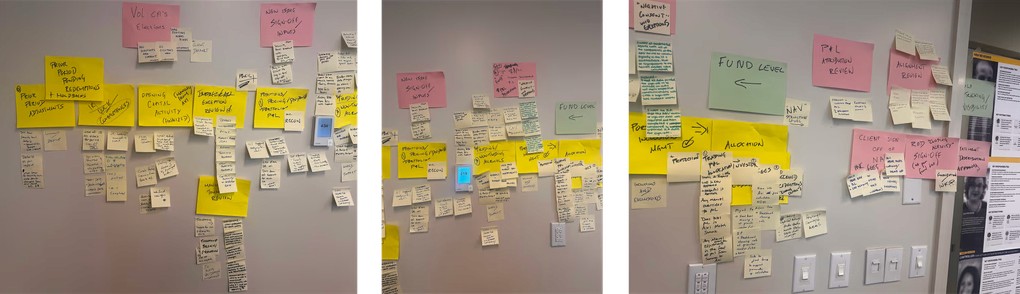
During the discovery phase of the project, myself alongside another designer kicked off the project by running a 3 day workshop with fund accountants and operation leads to understand the NAV process and the pain points that are associated with it.
Throughout the workshop, the design team facilitated breakout sessions for pain point clustering, journey mapping, prototyping sessions and presentations.
Pain Points Uncovered
📂
Scattered and Inaccessible Data
Visibility into data is very poor, with a high number of touchpoints across spreadsheets, shared drives and email, making information hard to find and reconcile.
🧠
High Cognitive Load and Error Risk
Preparers manually link exceptions to source data, relying on memory and sustained attention. This mental burden increases fatigue and creates opportunities for human error, especially under time pressure.
⌛
Inefficient and Reactive Workflows
Lack of clear prioritization or status tracking leads to duplicated effort and potential delays during close.
📊
Weak Auditability and Traceability
Approvals, decisions and resolutions are often captured through informal notes or spreadsheet comments, resulting in fragile audit trails that are hard to validate, reproduce, or defend during reviews.
🔍
Limited Real-Time Visibility
Preparers and reviewers lack a real-time view of progress, risk concentration, or emerging issues. This reduces their ability to intervene early or prioritize effectively.
🔐
Reduced Confidence in Data Integrity
Frequent exports, manual edits and version conflicts erode trust in the accuracy and completeness of control data, increasing verification effort and review time.
🔄
Manual Handoffs Between Roles
Work frequently involves a large number of touchpoints, including preparers, reviewers and managers via email or offline files, introducing delays, miscommunication, and accountability gaps.
Translating the Insights
Core Requirements:
NAV Overview Panel - Displays fund health, key indicators and outstanding actions.
Exception Management Center - List of issues with filters, severity indicators and resolution steps.
Task Workflow & Checklist - A guided step by step flow aligned with fund accountants expectations.
Fund Level Detail - Drill down capability into components such as pricing, reconciliation, fees, etc.
Audit & Compliance Logging - Ability to document items and communicate in-app.
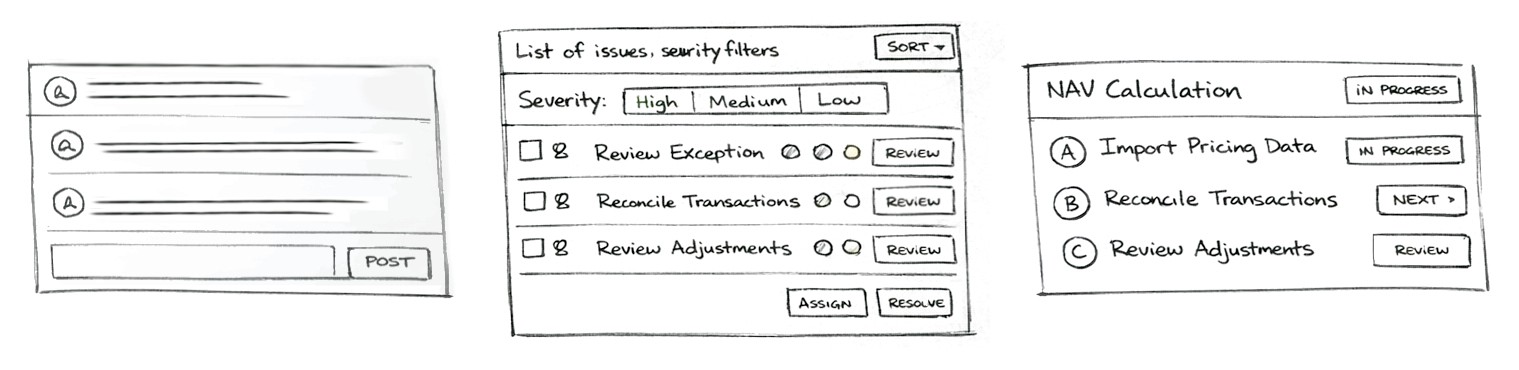
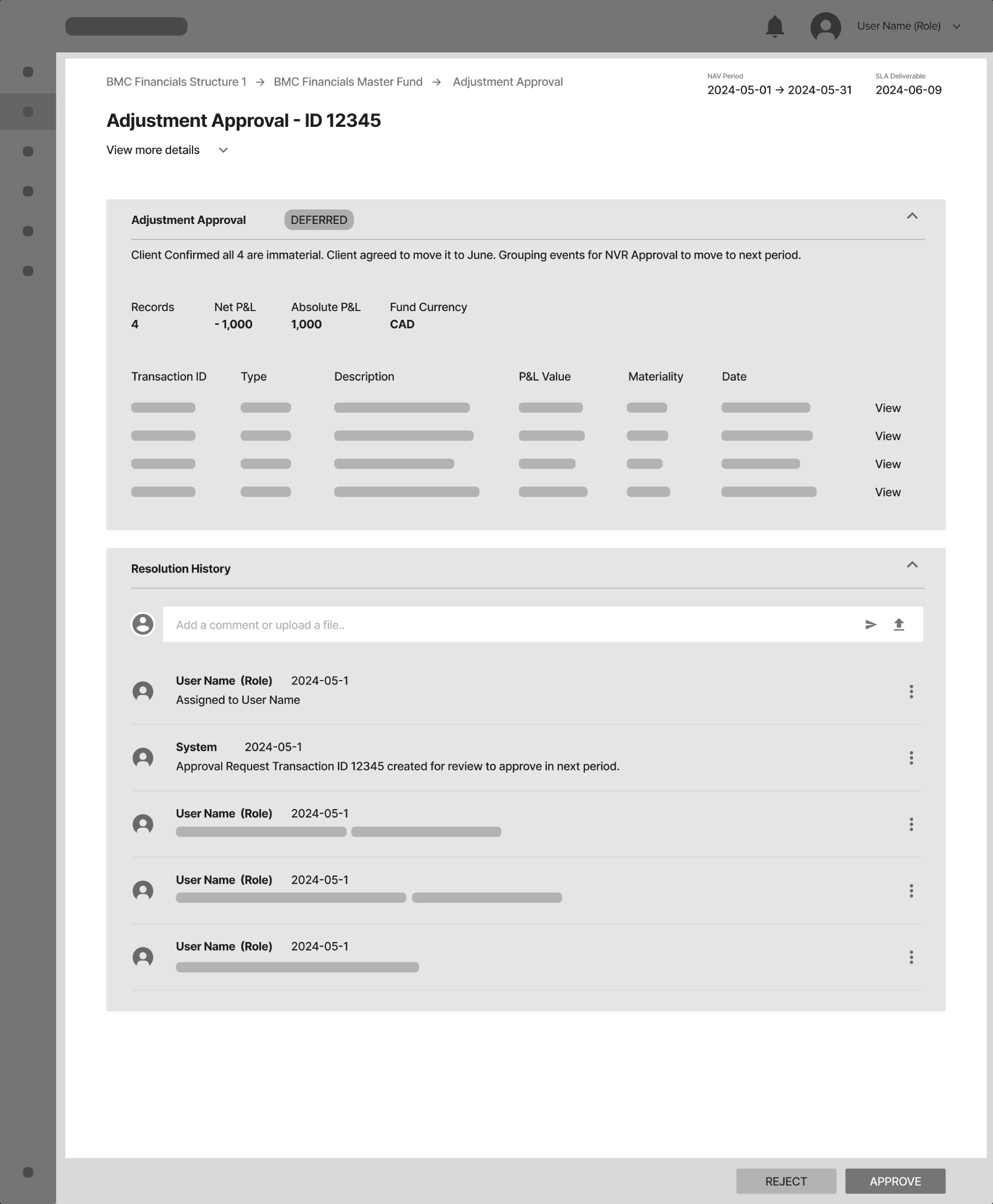
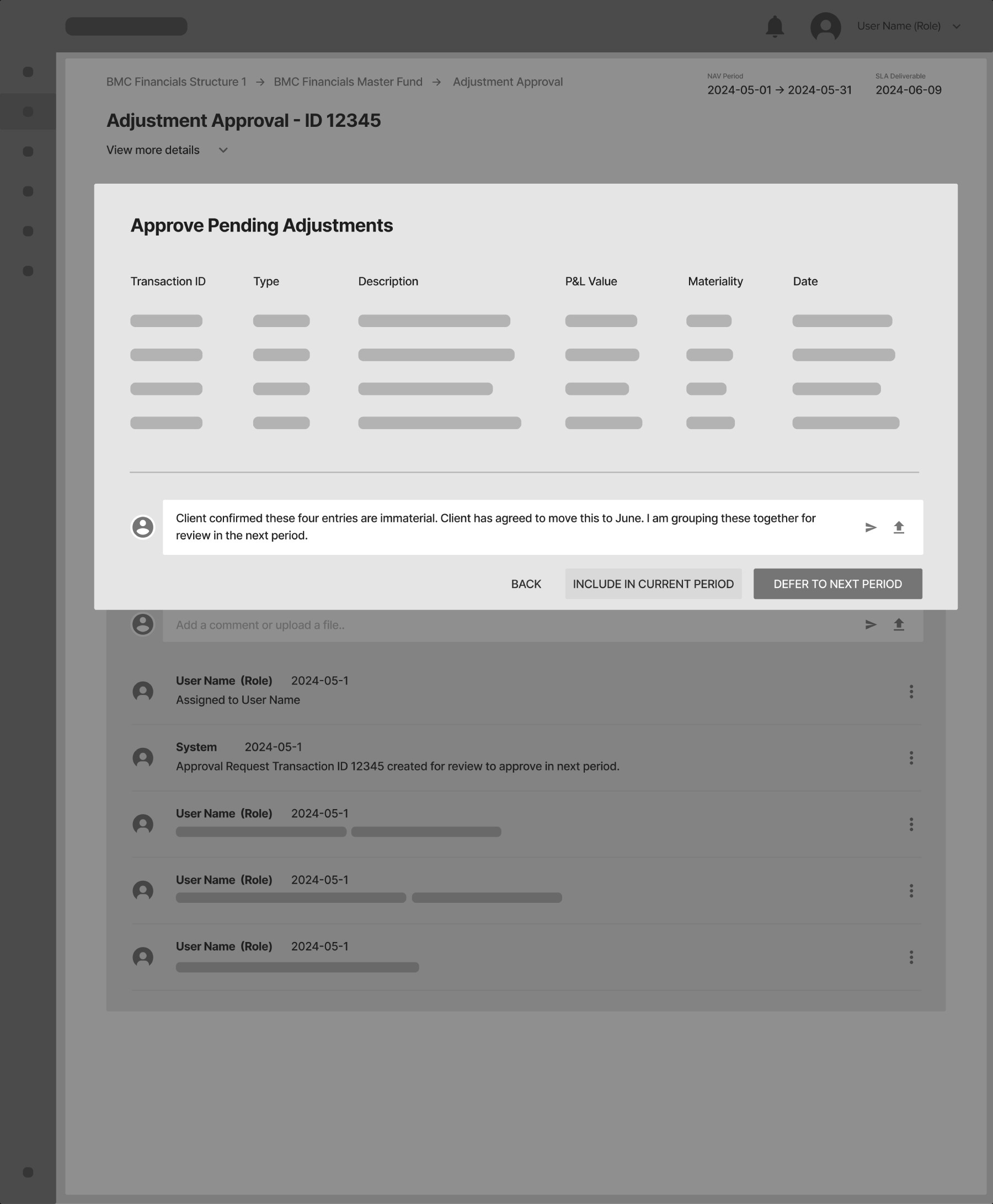
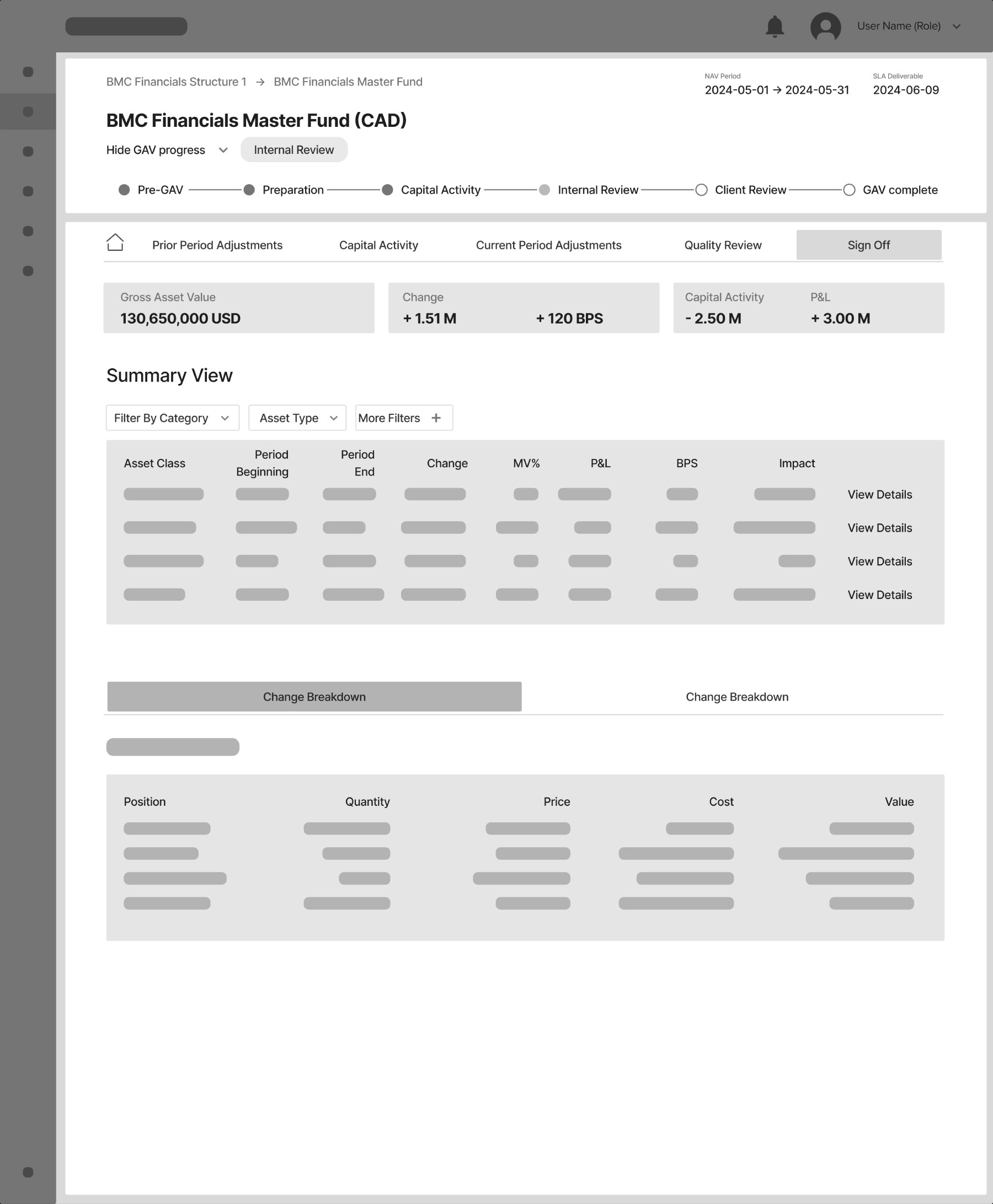
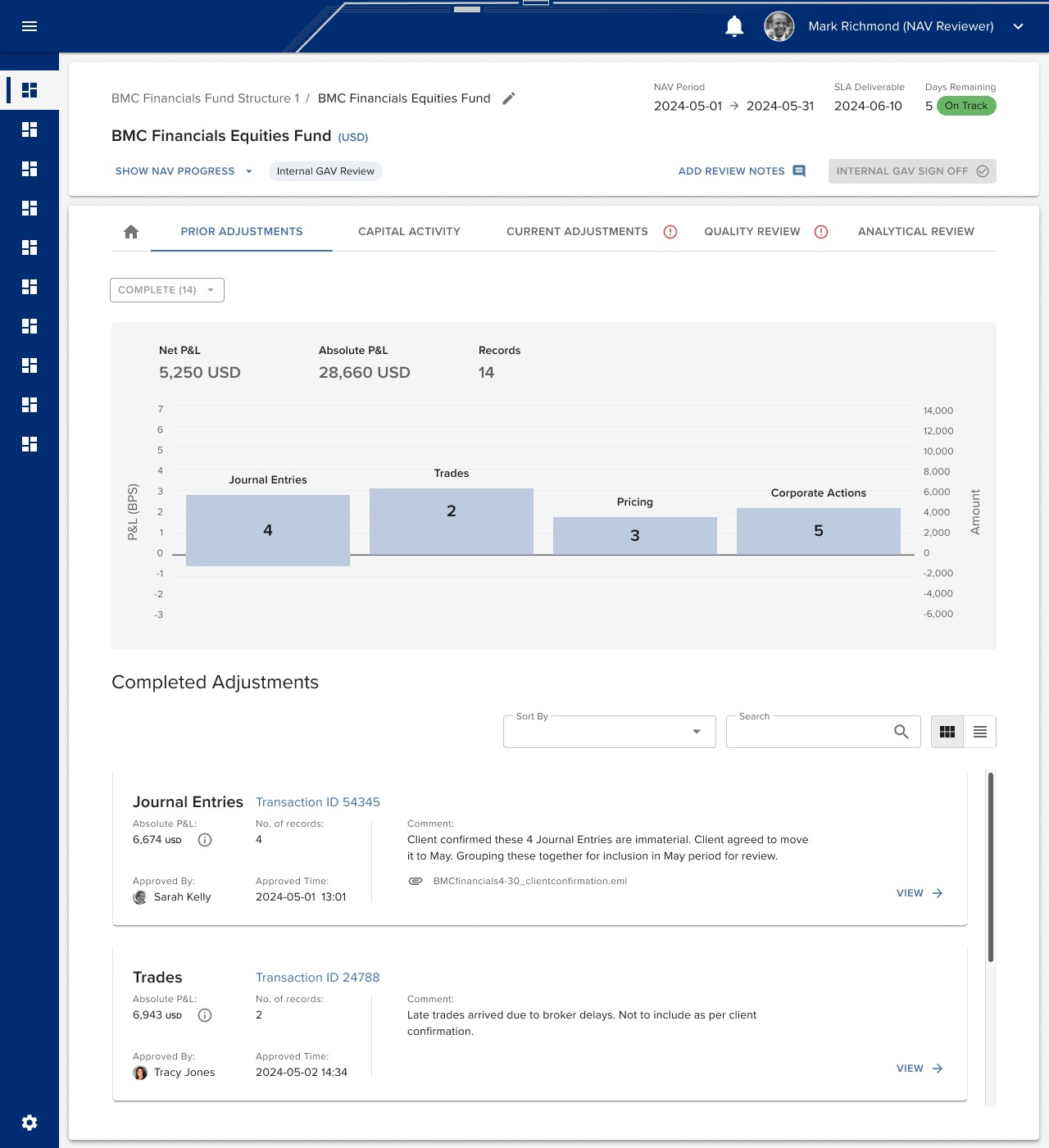
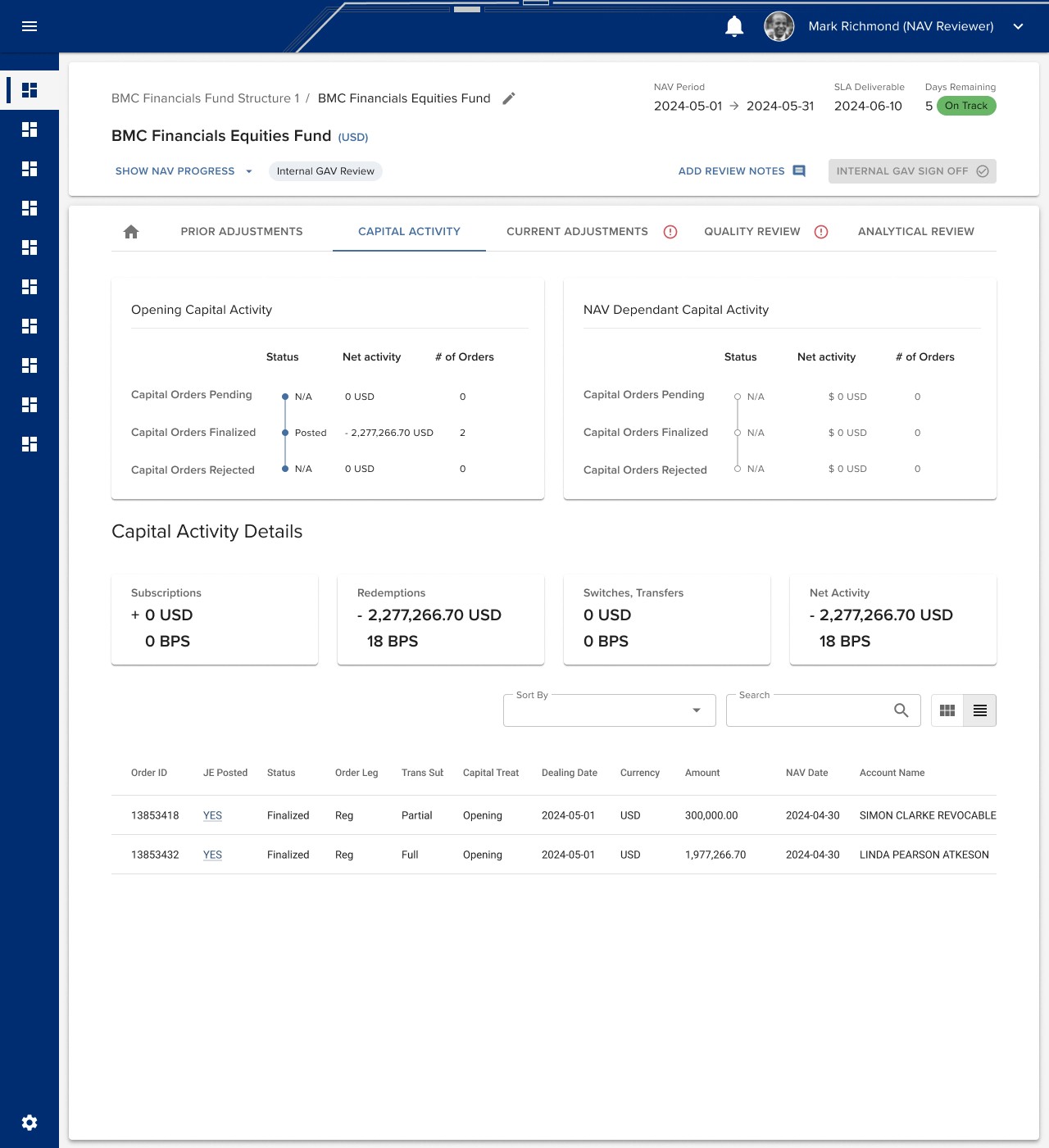
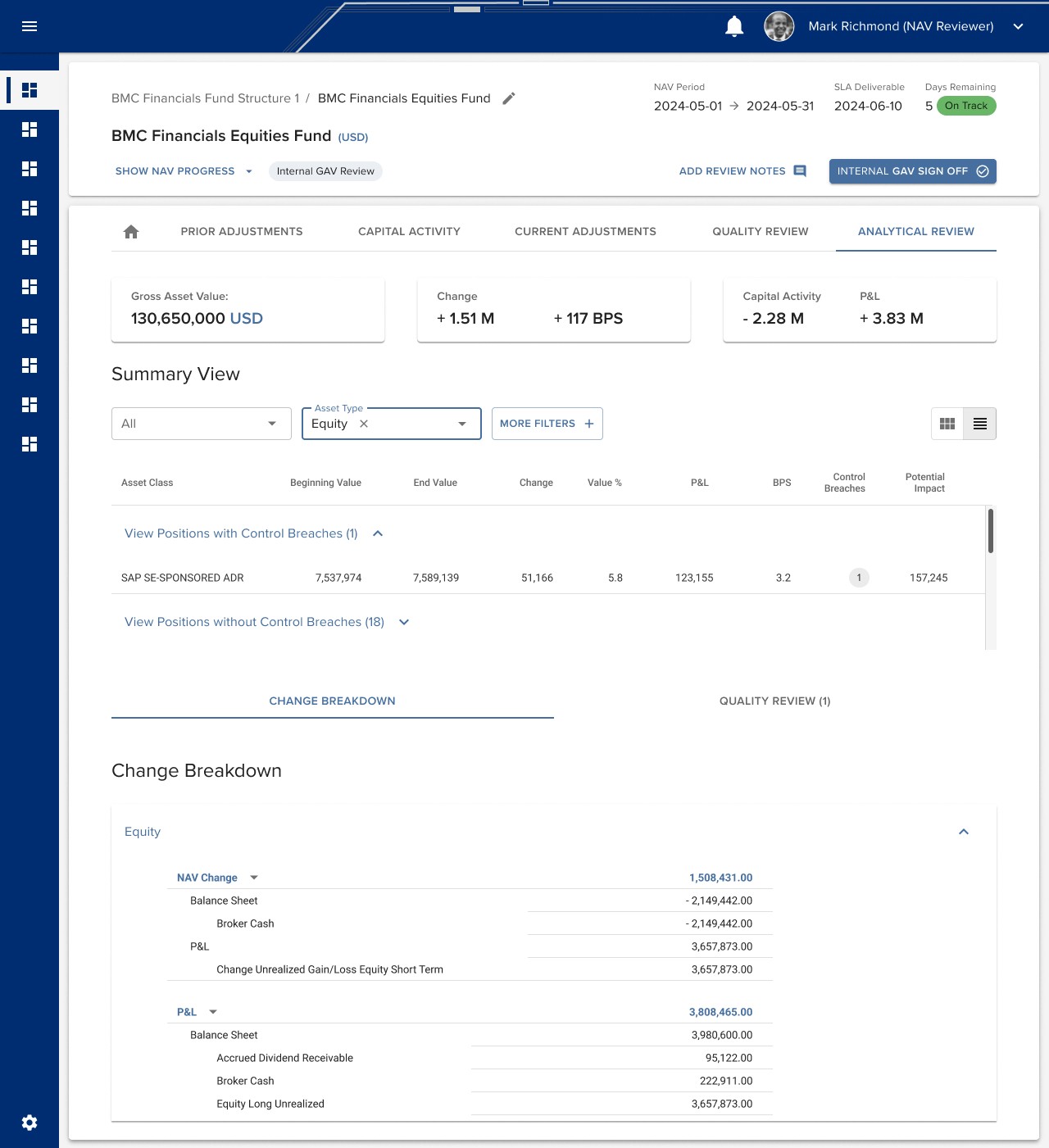
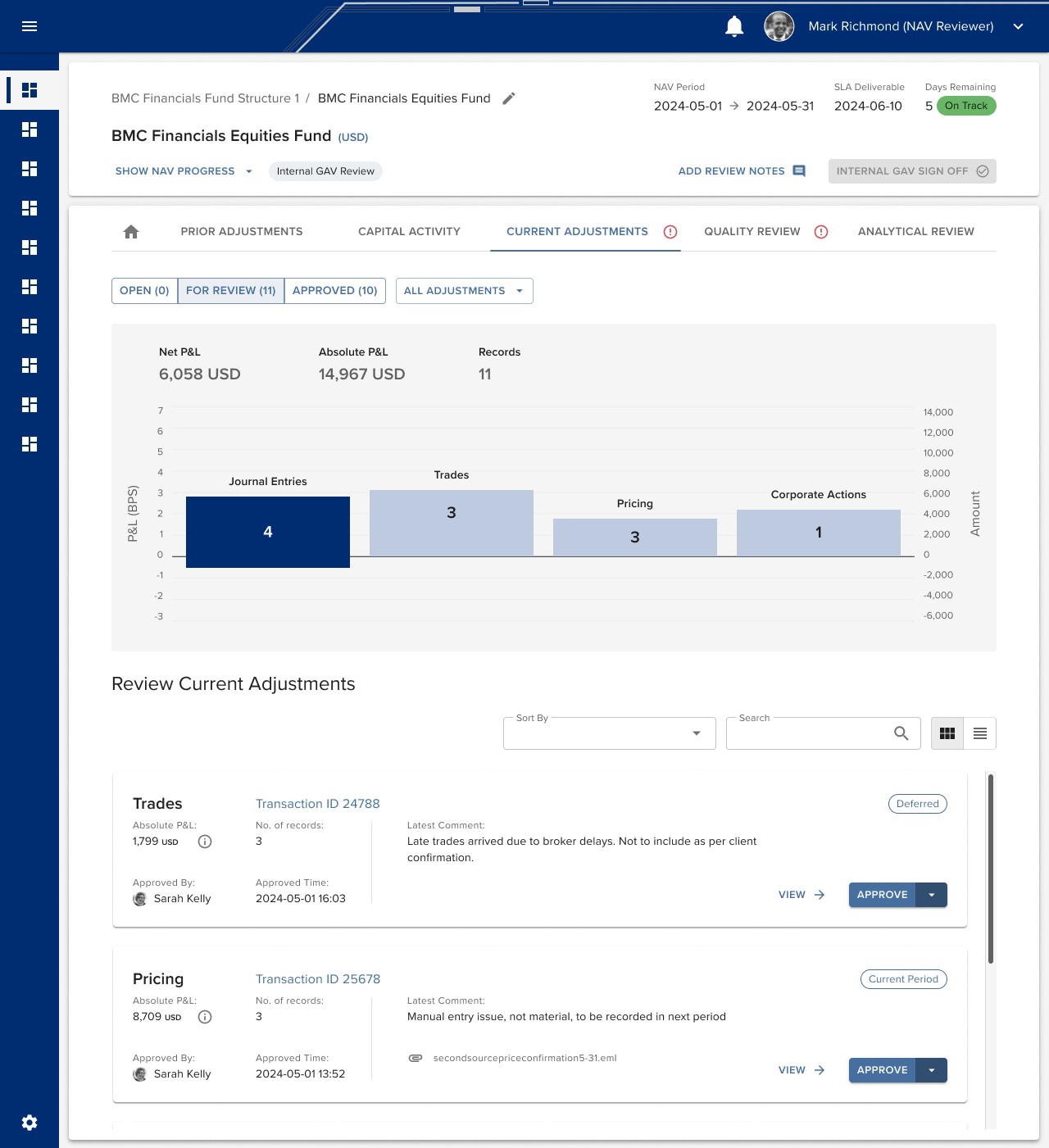
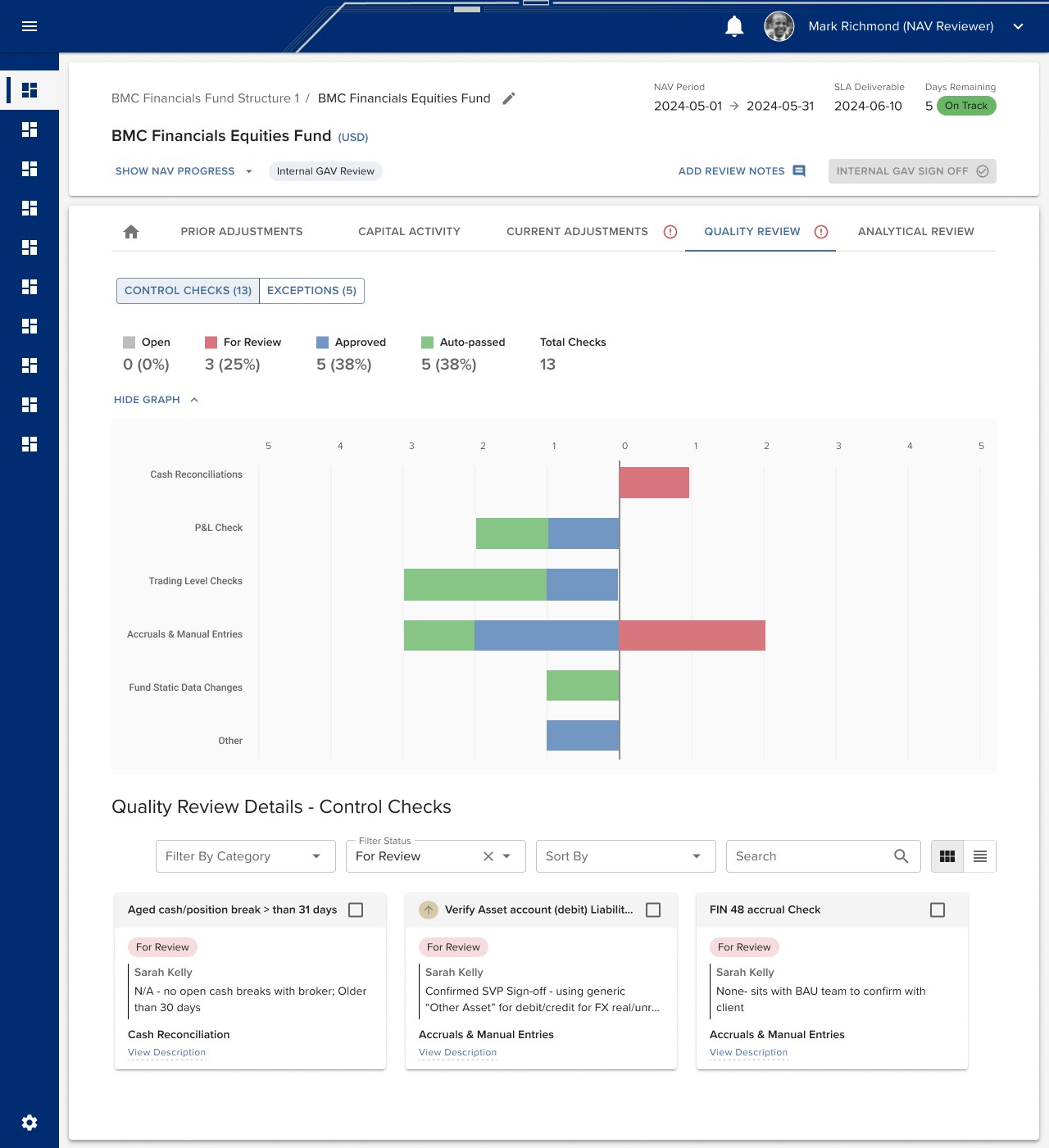
With core requirements defined, we moved into low-fidelity prototyping to validate structure and flow, mapping key user journeys, exploring navigation patterns and establishing an information hierarchy grounded in how fund accountants work. Insights from the workshop informed five primary tabs to anchor the experience around - Prior Period Adjustments, Current Period Adjustments, Capital Activity, Quality Review and Analytical Review - representing the most critical stages of the accounting process in a clear, unified framework.
The focus at this stage was structure, not visual polish: testing layout options, clarifying data relationships and identifying essential components needed to work confidently within the system. These wireframes established a scalable foundation that supported future expansion as the design evolved.
Iteration & Validation:
To keep the solution grounded in real workflows, we ran daily design standups with stakeholders and SMEs to review screens, validate assumptions and course-correct in real time. Through rapid iteration, the wireframes evolved to incorporate realistic data and reflect day-to-day complexity. This culminated in a clickable low-fidelity prototype that validated key user journeys and established a solid structural foundation before moving into higher-fidelity design.
Polishing the Pixels
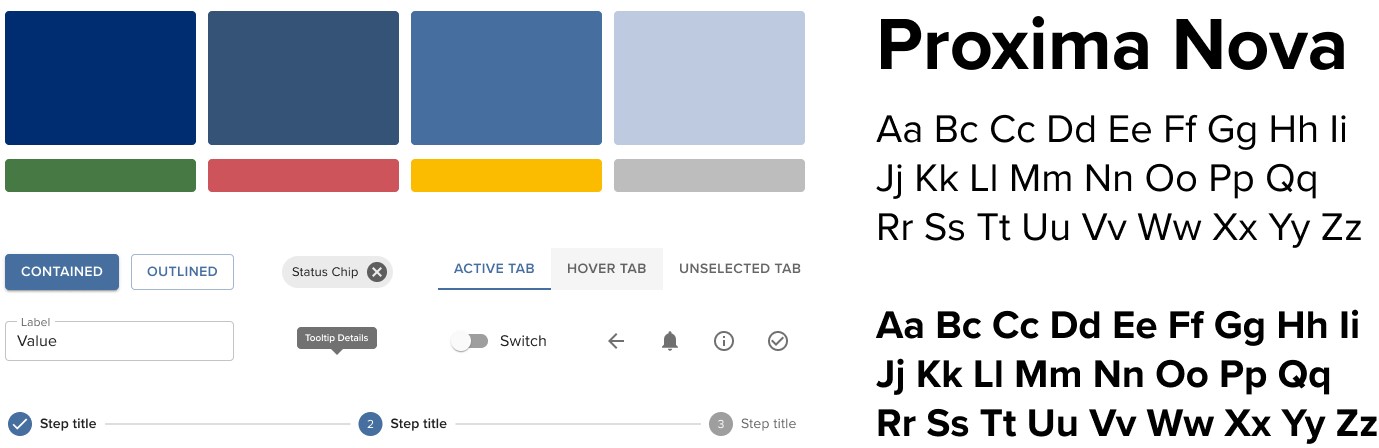
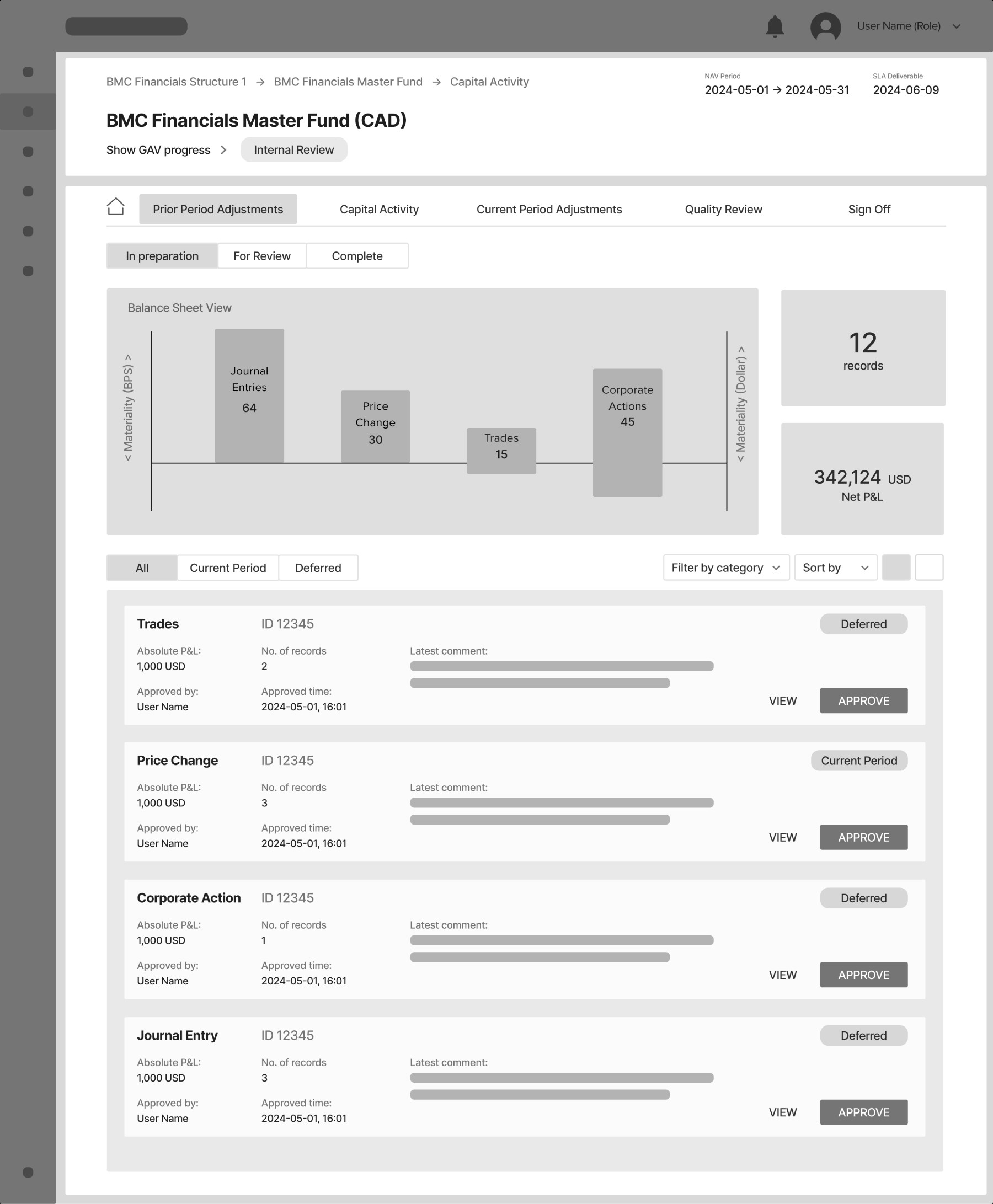
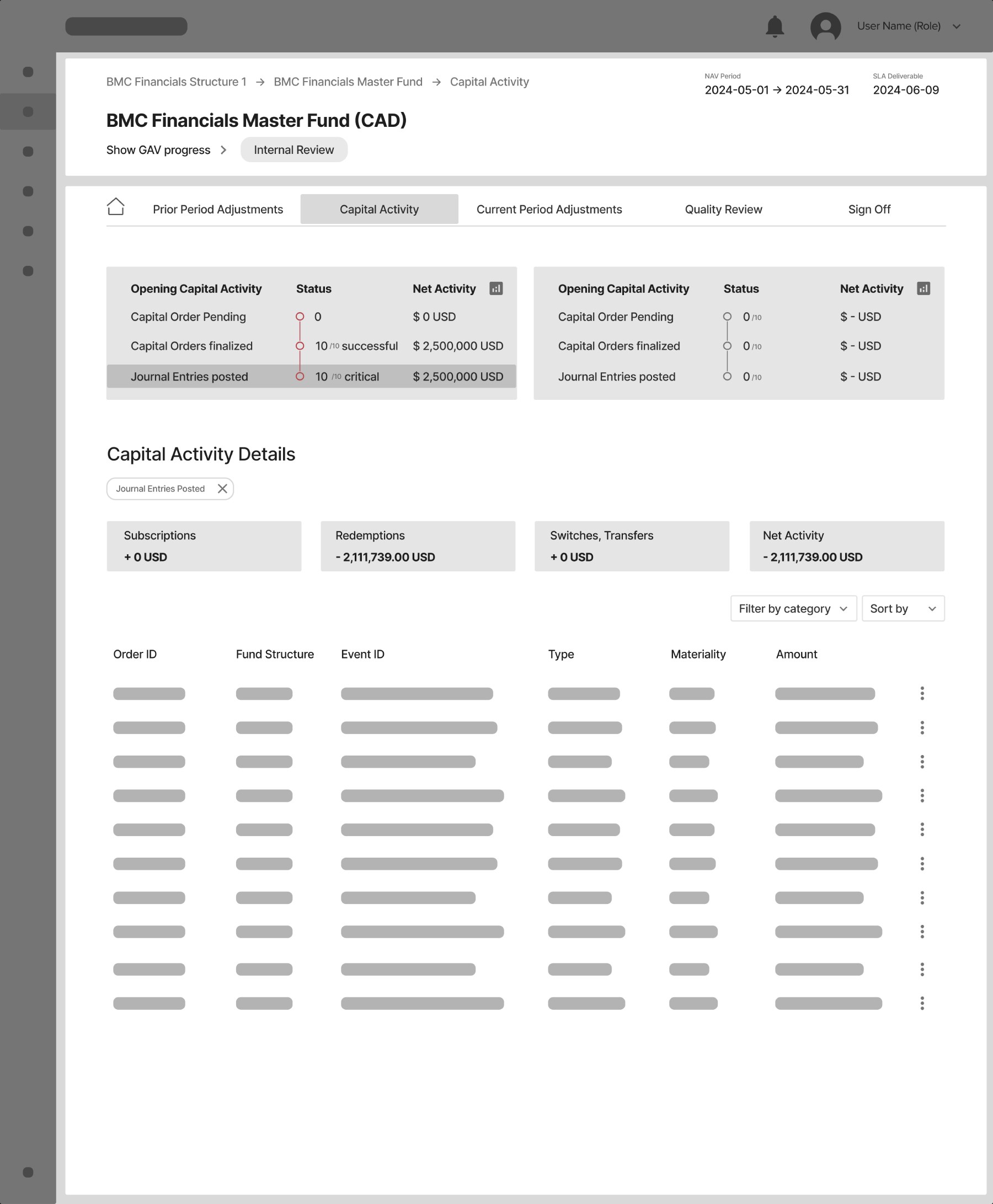
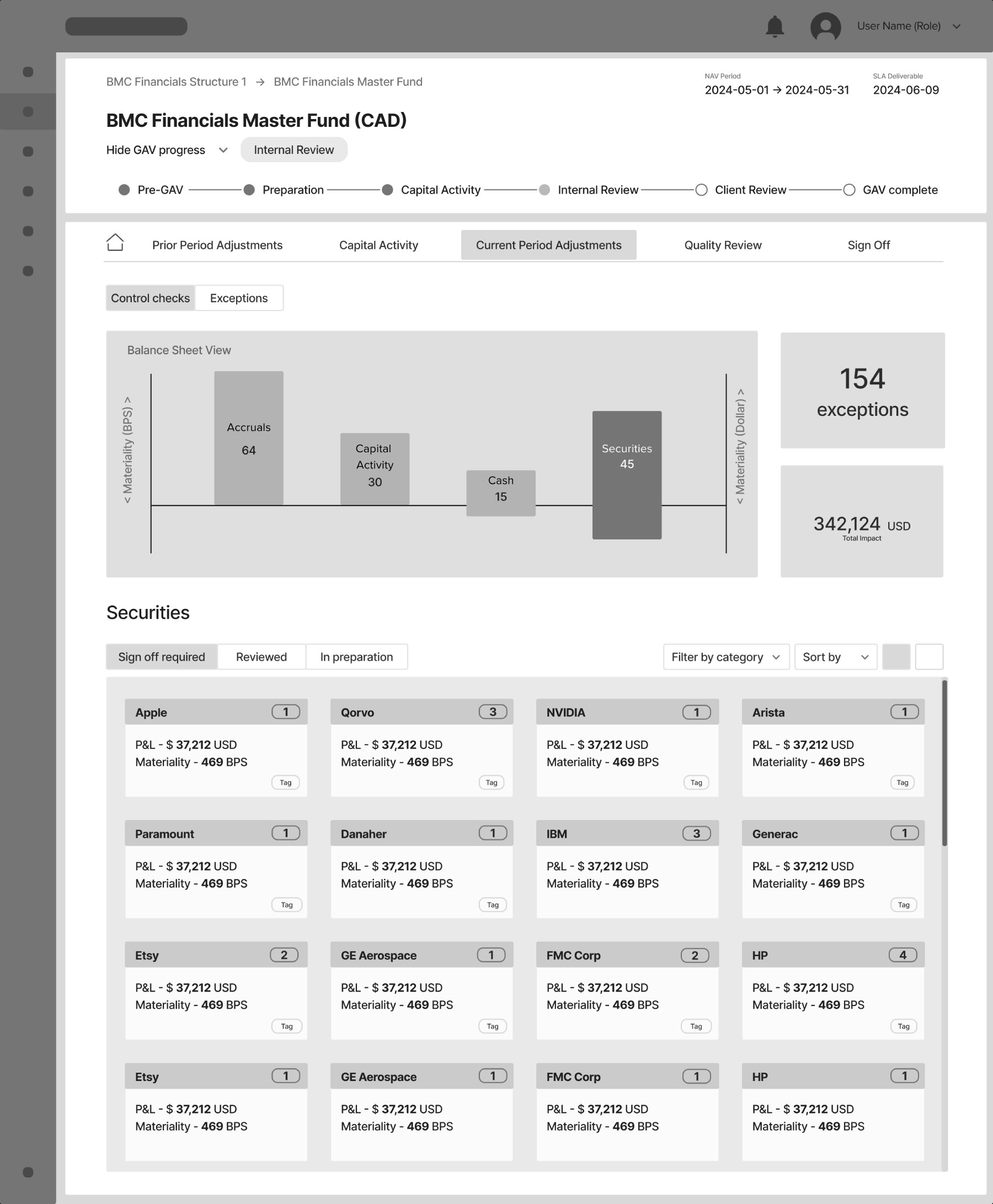
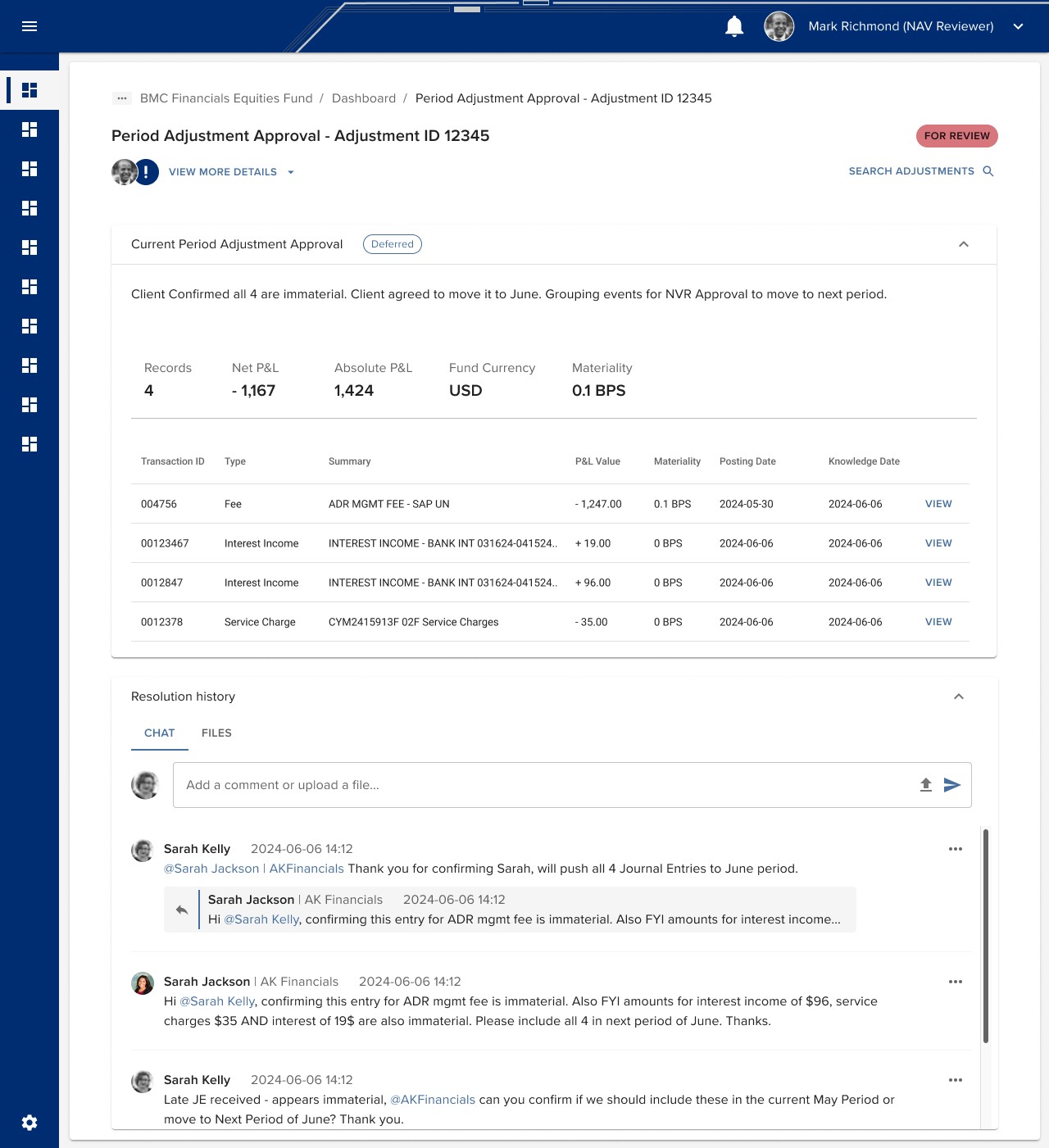
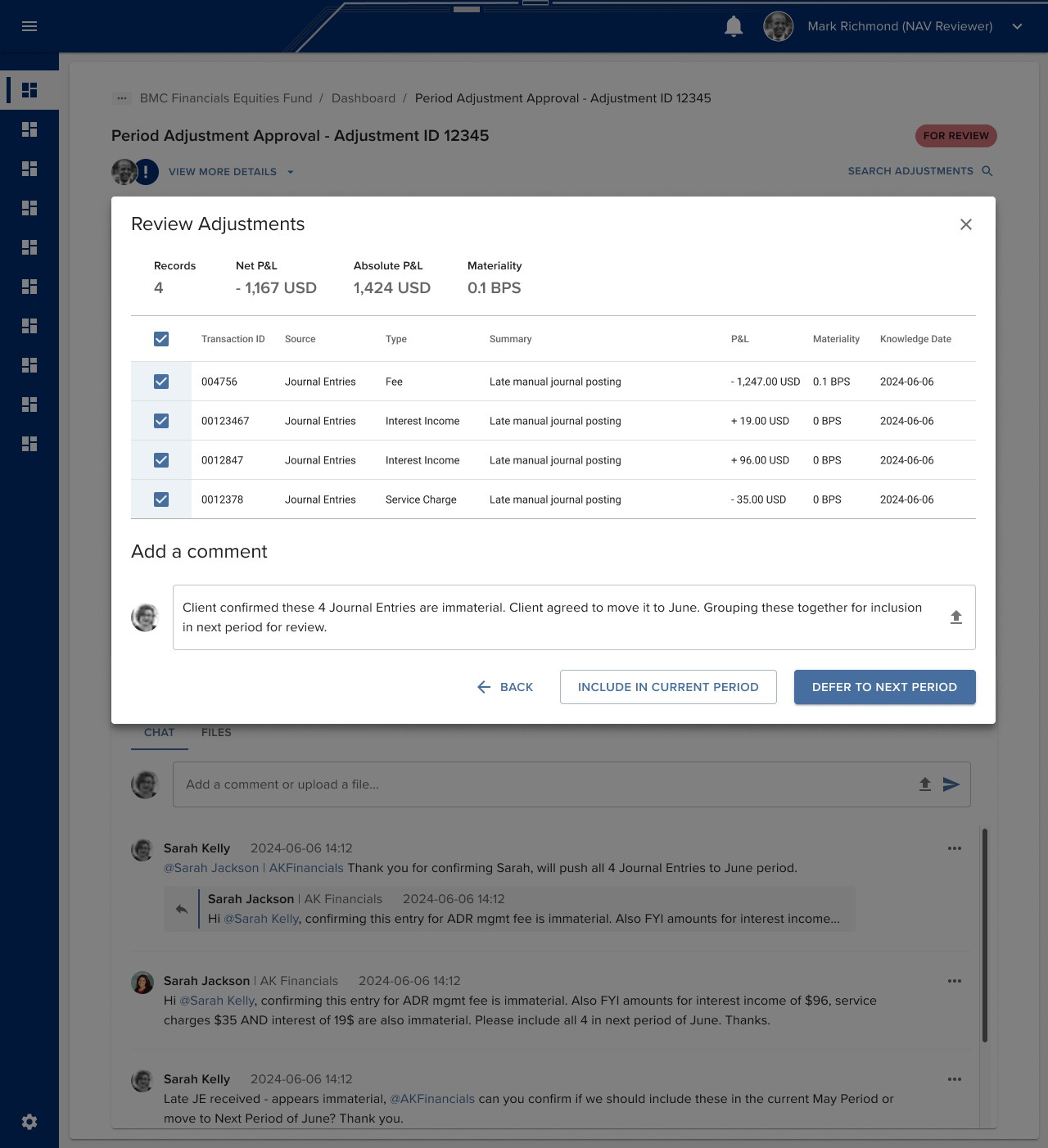
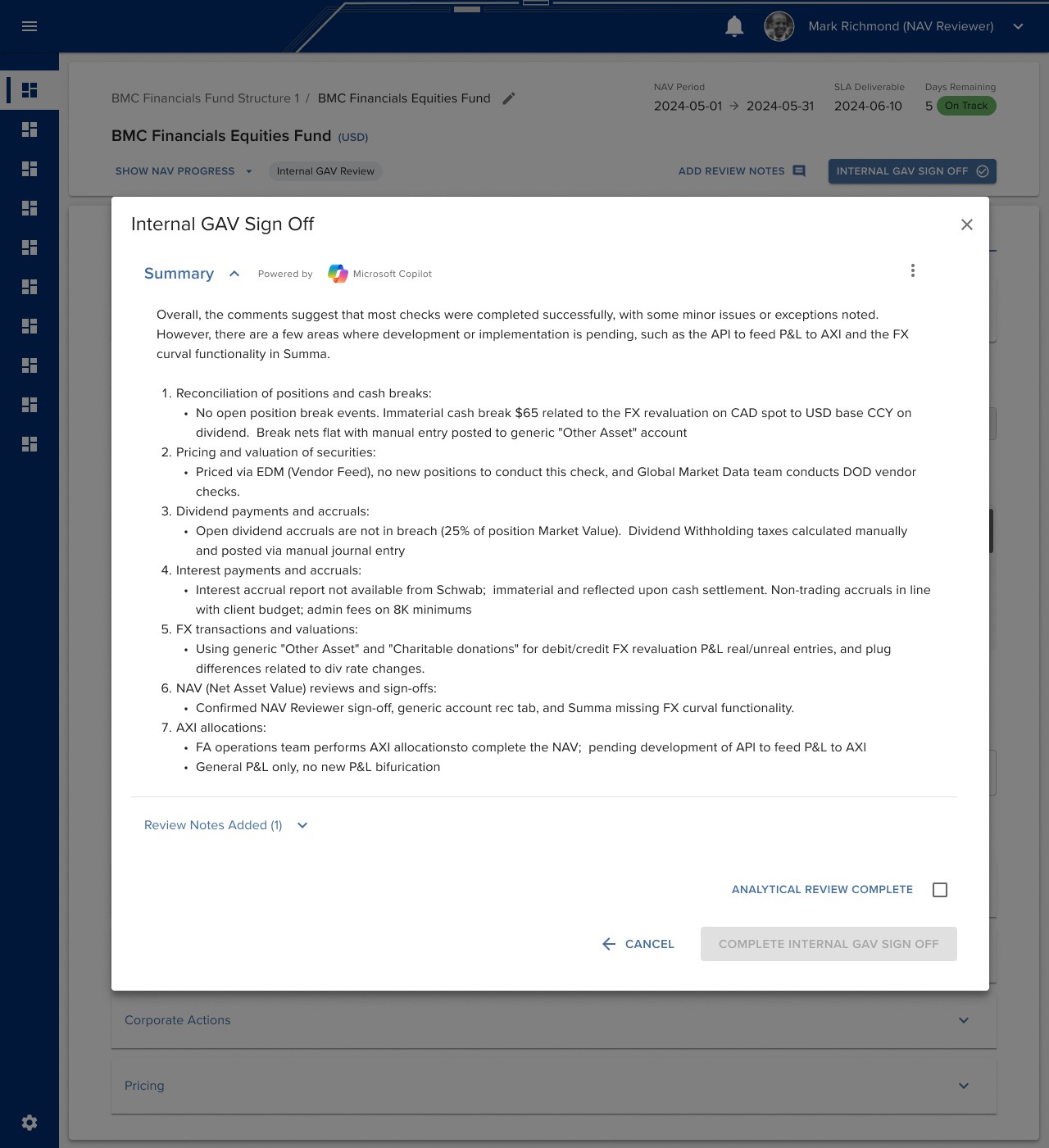
Leveraging the internal design system, validated low-fidelity screens were transformed into high-fidelity designs. To streamline production, I audited and grouped screens by core components - cards, charts, tables, logs and grids, allowing for rapid assembly and consistent use of established UI patterns. Through iterative reviews with product and business stakeholders, the designs were refined to meet both functional and visual standards, then brought together into an interactive, end-to-end prototype.
Key High Fidelity Enhancements:
Informed and clear visual hierarchy with intuitive grouping and progressive disclosure.
Status badges, alerts and confidence indicators for quick assessment.
Interactive charts and data tables with real-time filtering.
Collapsible sections to reduce cognitive load.
Responsive table and grid systems optimized for multi-monitor workflows.
Realistic user flows with simulated client data to represent a final product for stakeholders.
Leading with Insight
Each design decision was intentionally mapped to critical user and business pain points: reducing errors, accelerating NAV close, increasing trust in data and minimizing operational friction across senior fund accountants and reviewers. The dashboard was designed not just as a new interface, but as a long-term replacement for legacy systems.
Designed as a Single Source of Truth.
Pain points
Fragmented tools, manual reconciliation, low confidence in data.
Decision
Centralized NAV data, validation states and workflow context into one operational workspace.
Why?
Users need confidence, not just access. By centralizing data and surfacing its validation state clearly, the design reduces the need to cross-check multiple systems and spreadsheets. This directly supports faster NAV preparation and review while lowering the risk of human error.
Translating Grids into Data Visualisation
Pain points
Data overload, offline files, fragmented data.
Decision
Data visualisation, where it makes sense.
Why?
Large data grids forced users to manually scan and compare values, increasing cognitive load and slowing decisions. Translating key information into visual summaries enables faster pattern recognition and clearer risk identification at a glance.
Exception-First Experience to Shift from Reactive to Proactive Work.
Pain points
Late discovery of issues, reactive firefighting, high stress during close.
Decision
Prioritized exceptions, risk indicators and status visibility over exhaustive data display.
Why?
In practice, users do not need to review every value, they need to know where things have gone wrong. This shift from data-first to exception-first design allows users to focus attention where it matters most, reducing escalations and improving overall control of the NAV process.

One Shared Experience for Preparers and Reviewers.
Pain points
Misalignment between roles, duplicated effort, unclear ownership.
Decision
Designed a shared experience with role-appropriate depth and decisions rather than separate role-based tools.
Why?
Both roles work from the same trusted data while accessing the depth they need, improving communication, escalations, handoffs, alignment and decision confidence.

Reduced Cognitive Load Through Strong Hierarchy and Progressive Disclosure.
Pain points
Data overload, fatigue, slow comprehension.
Decision
Surfaced high-level status and actions first, with progressive disclosure drill-downs only when necessary.
Why?
Keeps focus during time-sensitive moments like NAV close, while still supporting deep investigation when required.

Designing for Long-Term Replacement and Organizational Change.
Pain points
Legacy system rigidity, difficulty scaling, resistance to adoption.
Decision
Because this was a net-new product intended to replace an existing solution over many years, it was designed with incremental adoption and scalability in mind - modular layouts, extensible components and patterns that could evolve without redesigning the core experience.
Why?
This approach supports gradual migration, reduces risk and ensures the system can grow alongside regulatory and business changes without overwhelming users or engineering teams.
Validating Decisions with Users
Usability testing focused primarily on validating a new end-state user flow. Beyond surface usability, my goal was to confirm real-world readiness, ensuring task efficiency, data sufficiency for decision-making and confidence in sign-off.
Sessions were moderated and remote, with fund accountants acting as NAV reviewers using a high-fidelity, data-realistic prototype. Task-based walkthroughs and think-aloud feedback revealed both user behaviour and decision rationale.
Each session was documented in real time and synthesized across themes and severity, providing clear, actionable insights to refine the experience.

Test Participants
Testing was conducted with 8 users of varying experience, roles and seniority.

Cross Regional
Participants were located across different regions, including EU, APAC and NA.

Guided Approach
Participants were guided, observed and questioned throughout scenarios.
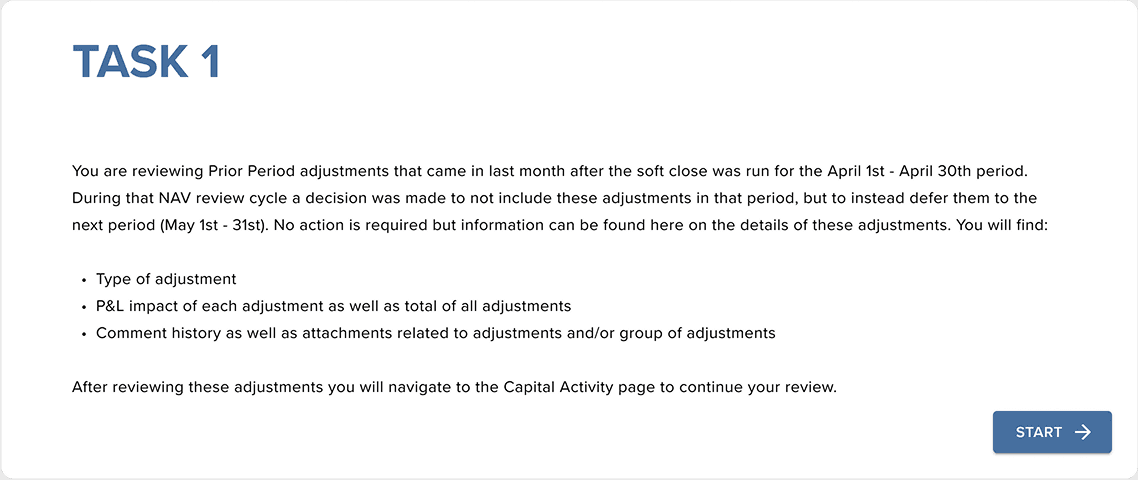
As the concept was significantly large and complex, I structured the test into focused, task based segments - one task per tab. Before beginning, participants were introduced with a brief task which instructed them to complete a specific goal.
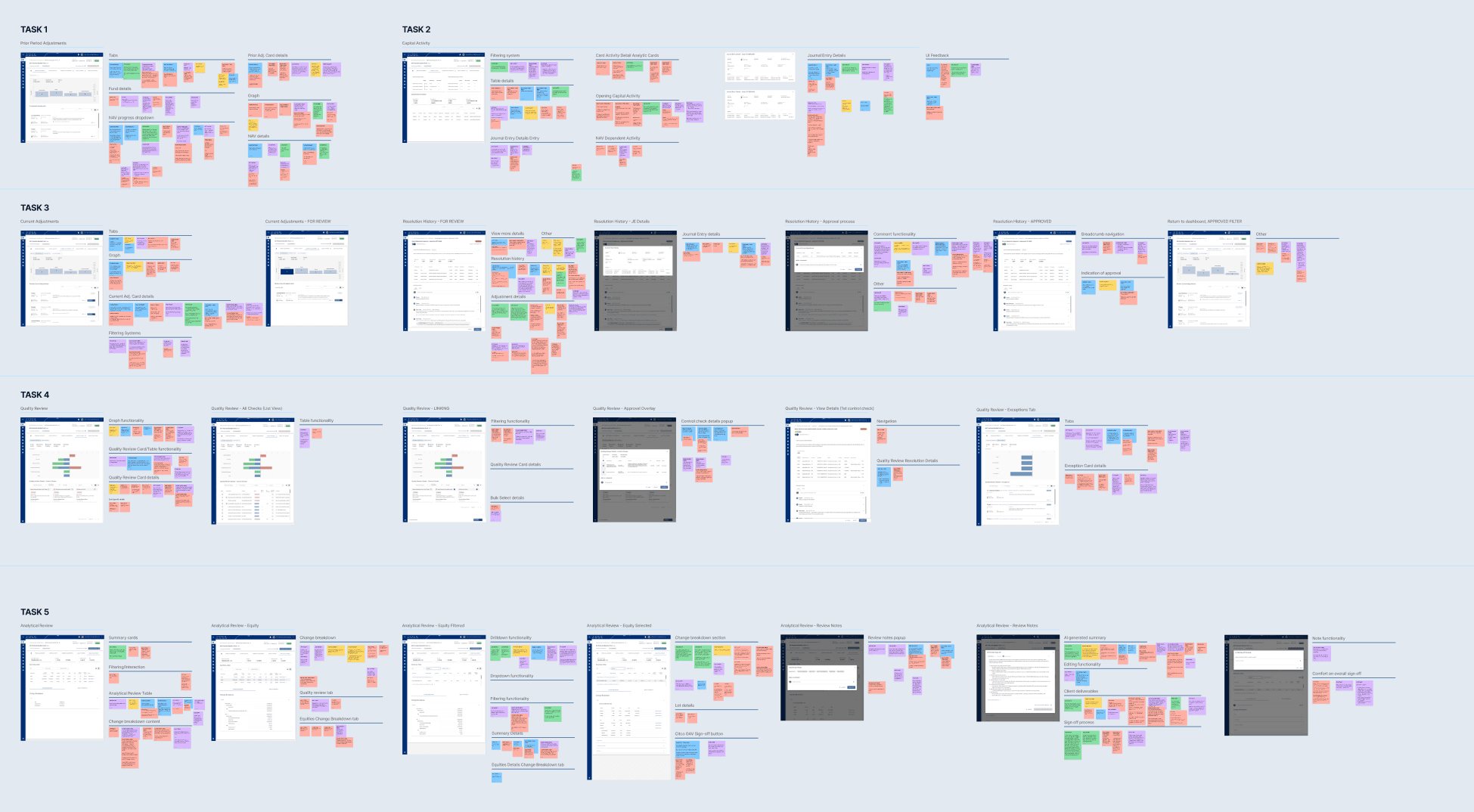
Each usability test involved the test participant, myself as the lead interviewer, a business sided SME and one note taker. The call was hosted on Teams, transcribed and recorded for further analysis and any potentially missed items. Each test was captured on Figjam in real time, sectioning out each task accordingly and synthesizing notes across varying themes and severity.
Measuring the Impact
Measurable Efficiency & Operational Simplification
The redesigned platform delivered a ~25–35% improvement in task efficiency, driven by improved data visibility, clearer task progression and a ~70% reduction in operational touchpoints across the NAV review workflow. By centralizing previously fragmented information and actions, the experience reduced handoffs, manual follow-ups and cognitive load for reviewers.
“
Even being the first time, the process looks clean and it seems very easy to navigate. Looks like it will be very beneficial.
”
Intuitive Navigation & Faster Decision-Making
Participants consistently demonstrated a clear understanding of navigation and next steps, even without prior exposure to the platform. Reviewers were able to locate critical information, identify exceptions and progress tasks with confidence, reinforcing the effectiveness of the workflow structure and information hierarchy.
“
The dashboard looks clean. All of the standout data I need to see is big and easy to read.
”
Reduced Friction Through Transparency & Traceability
The platform enabled reviewers to work with greater confidence and fewer interruptions by providing centralized visibility into upstream activity, contextual exceptions and communication history. Integrated messaging and traceability reduced reliance on email and manual follow-ups, while supporting clearer accountability and auditability across internal teams and client interactions.
“
It presents exceptions from other departments, connecting the dots and helps me to understand the entire process. The preparer could send a message seamlessly to the reviewer or the client.
”
A Step Change in the Digital Review Experience
When compared to existing tools and workflows, participants described the proposed dashboard as a significant improvement over current-state processes, particularly in how upstream activity, client interactions, and exceptions were surfaced. The experience shifted the review process from reactive and fragmented to proactive and transparent.
“
Today, I don't have a good view into what has been done upstream. On this dashboard, it's all at the forefront so I can see everything housed in the one place.
”
Reflections
The project presented a unique challenge: translating a highly complex and multi-step process (the NAV journey), into an intuitive and efficient digital experience.
Designing this dashboard and re-imagining the core business experience was a very challenging, but rewarding experience. Through close collaboration with SMEs, I gained a strong understanding of the users workflows, pain points and priorities, which directly informed the design. Designs were continuously iterated upon, compromises and challenges were overcome, strong opinions were raised and understandings were always met - the life of a designer.
One of the most valuable outcomes of the project was seeing the prototype validated through usability testing and pushed into development. Test participants, all of whom were active fund accountants, found the interface clear, the information architecture logical and the tools well-aligned with their real-world tasks. Their feedback confirmed that the dashboard had huge potential to reduce friction in their daily work and help streamline the NAV process from start to finish, aligning with the predetermined guiding principles. This project reinforced the importance of domain immersion, iterative design and early user involvement. It also highlighted how design can play a critical role in optimizing complex financial workflows.
While it’s tempting to view designs as “final”, in practice they continue to evolve. As work moves from concept through sprint execution and into production, new insights often surface that reveal opportunities for improvement. Thanks to a highly collaborative team, we’re able to identify these moments quickly and adjust the design in stride, ensuring the solution continues to improve rather than stagnate. This dashboard is still an ever-growing behemoth that I continue to work on, with constant screens, experiences and user journeys being explored and added for various users, both internal and external.